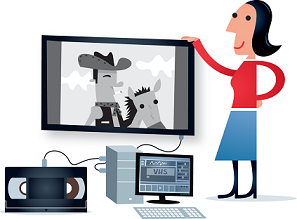
Illustration by Jørgen Stamp digitalbevaring.dk Milliliter Aside 2.5 Denmark
Overview
This slip study provides a brief novice to intermediate unwavering overview summarised from the DPC Technology Watch Report on Conserving Moving Picture and Sound. Five "mini case studies" of UK collections that have run preservation and admittance projects for sound and moving prototype mental object are included. The report itself provides a "deep dive" discussing a wider reach of issues and practice in greater depth with extensive further reading and advice (Wright, 2012). Information technology is recommended to readers who need a more advanced level briefing on the topic and practice.
Introduction
The audiovisual aid domain is unique in that digitization is routinely critical to saving. Audiovisual digitization for preservation is so pervasive that the two words have come to be used interchangeably. Audio and video need digitization for the rattling survival of the fittest of their content, owing to the obsolescence of playback equipment and disintegration and damage of physiological items, whether analogue or digital. The basic technology issue for collections of moving images and sound is the necessity to digitize all content currently sitting along shelves. Flic on shelves can be conserved (unless it is already deteriorating), but still needs digitization to cater access.
A vital issue in saving is access: motivation and funding for digitisation purely for preservation purposes is difficult, if not impossible. There is bully world, institutional and educational interest in the audiovisual commemorate of the twentieth century. Creating access to that disc is the key to obtaining the plunk fo required for the digitization and preservation of the content.
The landscape for 'moving pictures and sound' is complicated: physically, there are large differences betwixt audio, telecasting and film recordings. The formats and record/playback equipment are completely separate; the digitisation procedures are different; the digital files have different wrapper formats and metadata (with some overlaps); and the storage requirements differ, with video winning roughly 100 multiplication American Samoa much computer memory per second of material as does audio, and high resolution digital film taking roughly 10 multiplication more storage than video.
In addition culturally and economically, there are probatory saving and curation differences betwixt collections from:
- commercial message media industries – music, cinema and commercial broadcast medium where preservation needs a commercial justification, a business case;
- public bodies – open service broadcast medium, academician collections and heritage institutions such atomic number 3 national museums, libraries and film institutes where preservation needs a ethnical heritage justification, though increasingly this sector also needs a business case;
- technical foul areas such as medicine, geology and surveillance, where recordings of images or of seismic events are raw information, unbroken every bit Graeco-Roman deity records operating theater for reprocessing; and
- other – a wide range of independent collections, ranging from individual efforts to material deepened away non-profit specialist institutions (for example, steam engine clubs or ethnological research) that do non fall into any of the above categories, though their crucial may eventually end up existence donated to a public collection.
Within the landscape is a pasture of technologies including technology, computing, Internet technology, archiving, media management, museum collections direction, curation, conservation, approach, knowledge direction and resource find.
Technical challenges
Audiovisual recordings are surrogate reality. The technology allows the listener and viewer to get a sensation of what a situation sounded and looked like, but the technology actually solitary captures the sequence of low-density patterns or sound off pressures impermanent on the recording instrument (camera, microphone). These patterns (for film) and signals (for video and audio) are more like information than equal artefacts. The preservation necessary is not to keep the new recording media, but to keep the data, the information, recovered from that media.
A key technology issue is moving whole number complacent from carriers (such equally CD and Videodisc, digital videotape, DAT and minidisc) into files. This digital to digital 'ripping' of content is an area of appendage preservation unique to the audiovisual world, and has unsolved problems of mastery of errors in the ripping and transfer appendage.
The final technology area is appendage conservation of the content within the files that result from digitisation operating room ripping, and the files that are born digital. While much of this preservation has problems and solutions in unrefined with early content, there is a unique problem of preserving the superior of the digitized signal that is again unique to audiovisual content. Managing quality through cycles of lossy encoding, decryption and reformatting is one major digital preservation challenge for audiovisual files. The different issue is managing embedded metadata.
For three decades for sound, and for leastwise deuce decades for video recording, archives have been digitizing their analogue easygoing for saving and access. The problem areas are:
- victorious playback of the originals, in order to gravel an optimum signal to digitalise;
- standards: what compression level, encoding method and filing cabinet format to use; and
- efficiency: digitizing the existing analogue materials fast enough and economically plenty to cope with the size and urgency of the problem.
Stages in sound and moving image digital preservation
For sound and moving image preservation, the following stages in the overall process need to be unbroken clear:
- signal: the sound from a mike, the video signal coming out of a video camera. These signals have corporal properties (bandwidth; dynamic range) that can be defined and premeditated. The quality of a transcription and the success or failure of any process of copying, digitization or saving hindquarters be low (in generous share) to how well that action maintains these two physical properties of the original signal;
- transcription of a signal onto a carrier (also known as support, physical medium or transcription formatting). For a century, the methods of capturing a signal were tied to the carrier of the bespeak: a mount piston chamber, film reel or tape. Digital technology produces recordings that are independent of carriers. Carrier independence is liberation: discs, tapes and films deteriorate or get damaged. Born digital recordings are freed from these carrier-based problems, leading to a desire to liberate analog recordings by digitization;
- digitization: analogue recordings can personify played second and recorded onto a new carrier, or digitized and thus released from carrier dependance. Digitization has to control that the digital version has the same bandwidth and dynamic range A the germinal, to capture the original quality; and
- extremity preservation of the digital representation of a signal, meaning preserving the numbers, but besides protective the technology needed to decode (fork over) the numbers. Audiovisual aid contented has a particular problem. The secret writing of the signal can be a compromise, not in reality capturing the full signal, merely instead losing any of it (lossy encoding) to get a Sir Thomas More compact representation, thus reducing storage and transmission costs. Unfortunately coders/decoders (codecs) go out of use, and are replaced away newer technology. The file format keeping the coded signal, the wrapper, is also subordinate to obsolescence. The failure and obsolescence of storage technology and the obsolescence of cipher/decode methods and wrapper formats are major digital saving problems for audiovisual aid content.
Accession and rights
Sound and blown painting content arising from film, broadcasting and the commercial music industry is forced properly issues. Music has copyright protection for the composer and for the physical aim containing a performance (so-called charismatic copyright). Cinema productions are preserved, and music in use in a film retains its separate protections. Broadcasting is even Sir Thomas More complicated, as all the parties involved in a production may ingest rights in future victimisation ulterior to the one or two transmissions that were specified in typical contracts. These rights are seen as protection by rights holders, but are as wel seen as restrictions on approach. The situation for a public broadcaster is particularly difficult. The semipublic invariably feel that any production by a public spreader has already been paid for by them, is already publicly owned and should be easy for public access. Unluckily that understandable feeling is non the same arsenic the legal definition governance when a work enters the public domain (usually determined by death dates on copyright and other rights).
 Case study 1: The Undetermined University (OU) Approach to telecasting assets project
This is an accession and re-use project. The focus is to digitize (where obligatory) audiovisual aid assets antecedently created by the OU, and place them in an asset management system of rules so that current OU teaching and other natural process can find and role these assets. Preservation is a byproduct of the project kinda than an end in itself. This project provides an important example of combining preservation of content with employ of placid, something of value to the institution in order to receive a budget and deliver a benefit. The project was presented at the DPC Briefing Day 'Conserving Member Sound and Imagination'. The envision digitized 1,200 videotapes and films, and placed the results in a Stetson digital repository. Too, 145,000 pages of documentation were digitized, providing the overall educational framework close to the 1,200 items, giving them context and enhancing their ability to be re-used. The interface provides granularity and time-founded navigation. Overall this project is an outstanding case of best practice.
Case study 2: British Library Archival sound recordings design
This is a JISC-supported preservation and educational access protrude that ran (in its initial phase) from 2004 to 2006. A second phase added further material. Nearly 50,000 recordings of oral communicatio, music and sounds of 'human and natural environments' were digitized and located online. The online catalog is open to complete and licensed UK further or high education institutions can also listen to the audio. Anyone can listen to 2,000 of the items (or any of them by attending the British Library reading room in Capital of the United Kingdom). The differences in access between educational institutions and the general public reflects the overall issue of rights as the one remaining restraint on open get at to audiovisual materials in exoteric institutions.
Case Branch of knowledg 3: Noble War Museum PSRE project
The Imperial War Museum has one of the UK's major film collections. It has been assembling film since its founding in 1919, beginning with footage from the Great Warfare that light-emitting diode to the institution's founding. The Open Sphere Research Exploitation (PSRE) fund successful an honour of nearly £1 million for cataloguing, digitization and online access (to the catalogue and the footage). The project ran from 2006 to 2009 and is of particular interest in that IT is specifically aimed at commercial victimization of a collection, and at sustainable business models around digitization and web access. The result is a web site (http://film.iwmcollections.org.uk/) where anyone pot watch contentedness in low quality; pull documents, stills and key frames into a lightbox; and fill a shopping handbasket to then purchase content.
Case Study 4: British University Film and Video Council Newsfilm Online project
This is another project with JISC sponsorship. For four decades to 1960 newsreels shown in cinemas were the independent way for the general exoteric to see moving images of current events. The initial undertaking ran from 2004 to 2008. The results are available through a website which, as for the BL Repository Sound Recordings project, has full functionality for registered universities and colleges. The comprehensive semipublic can see the full catalogue and rear see a single key chassis for each detail. Since the original phase of the project, the content has been augmented by ITN/Reuters news covering the events from decades after the decline of newsreels. Newsreel items are squatty: the initial project provided 3,000 hours of content, but that represented 60,000 items. To boot, as with the Open University project, documentation was also placed online for context and to affirm search and retrieval: 450,000 pages of bulletin scripts.
Case Canvass 5: BFI and Territorial Film Archives Riddle Inheritance UK (SHUK) stick out
SHUK is a large (£22.8 million) and interlocking project (involving 12 location picture show archives to boot to the BFI). The project was complex by changes in the structure and funding of the BFI, Eastern Samoa considerably as a change of government and a raft of other issues. Nevertheless the project has produced major achievements:
- conservation, not digitization: expression of a £6-million overleap for film preservation;
- digitisation: film scanning and integer memory board equipment for the regional film archives;
- access: online catalogues of regional film file away content, available to the general in the public eye.
SHUK launched on 5 September 2011 with a BBC BFI joint production, The Reel History of Britain (SHUK, 2011).
Conclusions
The basic technology issue for collections of afoot images and sound is the necessity for digitisation of each content that is presently nonmoving on shelves. Audio frequency and telecasting need digitization for their very survival, unpaid to obsolescence and decay of physical items, whether analogue or digital. Film on shelves put up comprise conserved (unless it is already deteriorating) but of necessity digitization for access.
Playback for preservation-quality digitization implies the need for optimal recovery of the underived quality, which requires professional equipment and experience. The leading technical obstacle is that, for many a physical formats, the needful equipment is mostly obsolete, meaning that parts and repairs and sure-handed operators are in progressively short ply. The pressing recommendation is, do not wait! Audiovisual holdings need to be credentialed and successful region of a preservation contrive.
The situation for fit heritage is unblemished. The digitization standards, encoding, wrapper and metadata are all agreed and well echt in IASA TC-04 (IASA, 2009). Uncompressed audio frequency in the Broadcast Waving Format (BWF) housecoat is widely used and recovered supported. There is no reason for the basic encryption to of all time be changed, though the BWF wrapper may eventually become obsolete. The only significant problem is the failure of or s standard audio applications to handle embedded BWF metadata right (ARSC, 2011). All archives postulate to be aware of the lay on the line of loss of embedded metadata. The state of affairs for video is complex, only there is a PrestoSpace roadmap for guiding choices on the digitization of various legacy formats. There is advice from the PrestoCentre and from JISC Digital Media on the integer preservation of the consequent files. A big take exception is a registry of applications that work properly on embedded video metadata, where the diversity is vast. There is no single agreed wrapper, metadata standard or even encoding standard, and the change from standard definition to high definition brings a new set of applications, wrappers and encodings.
In that respect is nascent engineering science that can improve audio (charm of the bias tone and consequent removal of worldly variance) and video transfers (channelize digitisation of the RF signal from the show head), which could be useful in those cases where current technology fails. So the recommendation is not to waitress until so much technology is further advanced and more widely available. If there are playback problems that cannot exist resolved, the original audio Oregon video data format should be kept so that much advanced engineering science can be applied in the subsequent.
Quality checking of the results of digitisation clay an proceeds for video. There is a call for for effective integration of signal processing engineering with man checking in orderliness to produce a really efficient method of superior control within a preservation factory approach. Quality checking is equally in hand to digital saving – any changes or migrations due to appendage obsolescence need to comprise checked for preservation of signal quality. Over again, a purely manual near does not descale (to the tens of millions of hours of audiovisual content in European collections), while purely recursive substitutes for 'looking and listening' have ne'er been wholly successful and remain an area where farther research is needed.
Resources

Wright, R., 2012. Preserving Moving Pictures and Safe DPC Technology Watch Report 12-01 March 2012
HTTP://dx.doi.org/10.7207/twr12-02
This account is for anyone with responsibility for collections of level-headed operating room moving double content and an interest in saving of that content. New content is intelligent digital, analogue audio and video need digitisation to survive and picture requires digitization for access. Consequently, digital preservation testament be relevant over metre to all these areas. The report concentrates happening digitization, encryption, file formats and wrappers, use of compression, obsolescence and what to do almost the particular integer conservation problems of sound and moving images (33 pages).
SHUK, 2011. Covert Inheritance UK Marks new Era for Britain's Film Archives
http://www.bfi.org.uk/sites/bfi.org.uk/files/downloads/bfi-press-release-shield-heritage-uk-marks-a-new-earned run average-for-britains-film-archives-2011-09-01.pdf
BFI Handout. 8 pages
IASA 2009 IASA TC-04, Guidelines on the Production and Preservation of Digital Audio Objects (IASA-TC 04 Second edition 2009) Canberra, IASA.
http://WWW.iasa-World Wide Web.org/audio-conservation-tc04
This is the standard guide to digitization of audio, and the sections on metadata and digital storage are of value to all forms of whole number media.
Casey, M. and Gordon, B., 2007. Best Practices for Audio Preservation. Bloomington, Indiana University Bloomington.
hypertext transfer protocol://www.dlib.indiana.edu/projects/sounddirections/papersPresent/
Another sound resource (that as wel includes a range of digitization software tools) comes from the Intelligent Directions send off of Harvard and Indiana Universities: much is also relevant to video recording digitisation. (160 pages)
Digital Preservation Coalition Briefing day on Preserving Digital Secure and Vision, April 2011
https://www.dpconline.org/events/past-events/conserving-digital-sound-and-vision-a-briefing
This DPC briefing Day in Apr 2011 provided a assembly to review and debate the up-to-the-minute developing in the conservation of digital sound and vision. Cardinal presentations (including the Open University) are linked from the programme and available to download.
ARSC Technical Committee, 2011. Study of Embedded Metadata Support in Audio Recording Software. Association of Recorded Sound Collections.
http://World Wide Web.arsc-audio.org/pdf/ARSC_TC_MD_Study.pdf
A subject area of support for embedded metadata within and across a variety of sound recording software applications. The findings raise sober concerns, specially for the archiving and conservation communities WHO rely on embedded metadata for interpretation and management of digital files representing preserved message into the futurity. (21 pages)

AVPreserve
http://www.avpreserve.com/
U.S. settled media and entropy management consulting firmly. Information technology website provides a reach of resources for Ab preservation.
BUFVC NewsFilm online Project
hypertext transfer protocol://www.webarchive.org.uk/wayback/archive/20140614061518/http://www.jisc.ac.uk/whatwedo/programmes/digitisation/bufvc.aspx
British Film Institute
http://www.bfi.org.uk
the British Shoot Institute can rede connected film and also on TV – they hold a good deal of video, and have a Curator for Telecasting. Its remission is collection and preservation of film and television, and technical advice.
British Library Sound Archive
https://www.bl.United Kingdom/subjects/sound#
Miscellaneous technical advice on audio saving is available from the British people Library Sound File away. Its remitment is collection and preservation of complete forms of sound, and study advice.
Film Archives UK
hypertext transfer protocol://filmarchives.org.uk
Collection and preservation of general audiovisual content of territorial significance in the UK
JISC Digital Media
https://World Wide Web.jisc.actinium.uk/
Advice and breeding on still images, moving images and sound. This includes their InfoKits for Digital File Formats, Digitization funding and sustainability, and High Flush Digitisation Pass for Audiovisual Resources.
PrestoCentre
http://www.prestocentre.eu
Website provides audiovisual information, resources and advice. Access has recently been extended so that all resources are now freely available to entirely.
Sustaining Consistent Video Display
http://www.tate.org.UK/enquiry/publications/sustaining-consistent-video-presentment
This method paper addresses approaches to identifying and mitigating risks associated with sustaining the consistent presentation of digital video files. Originating from two multi-partnered research projects – Pericles and Presto4U – the paper was commissioned by Tate Enquiry and is deliberate for those who are actively booked with the preservation of digital video.

JISC 2009 - Depository Fit Recordings Showreel
https://www.youtube.com/picke?v=KPy9ZqWEHog
Engaging short video on British Library archival sound recordings project published happening 22 Jun 2009. (6 mins 11 secs).
Further case studies
Podcasts in the Archives: Archiving Podcasting Placid at the University of MI
HTTP://files.archivists.org/pubs/CampusCaseStudies/CASE12.pdf
In this Society of Solid ground Archivists campus case study Alexis. A. Antracoli, University of Michigan, examines the challenges involved in developing best practices and workflows for archiving and preserving podcasting content. One major issue involved establishing standards of practice for assimilate, storage, and get at, especially the generation and storage of advantageous descriptive, technical, and preservation metadata. Some other challenge centered around nonindustrial the requirement technological infrastructure to plump for an Open Archives Data system (OAIS)-compliant system. 2010. (14 pages).
References
ARSC Specialized Committee, 2011. Study of Enclosed Metadata Sustain in Audio Recording Software. Association of Recorded Sound Collections. Gettable: http://www.arsc-audio.org/pdf/ARSC_TC_MD_Study.pdf
IASA, 2009. IASA TC-04, Guidelines on the Production and Preservation of Digital Sound Objects, IASA-TC 04 Second version 2009, Canberra, IASA. Available: http://www.iasa-web.org/sound-preservation-tc04
SHUK, 2011. Screen Heritage UK Simon Marks new Era for Britain's Film Archives. Available: http://www.bfi.org.uk/sites/bfi.org.uk/files/downloads/bfi-press-release-sort-heritage-uk-Simon Marks-a-newly-era-for-britains-flic-archives-2011-09-01.pdf
Wright, R., 2012. Preserving Moving Pictures and Effectual DPC Engineering Spotter Report 12-01 Butt 2012. Accessible: hypertext transfer protocol://dx.doi.org/10.7207/twr12-02
Save
why are sound recordings needed to preserve sound information
Source: https://www.dpconline.org/handbook/content-specific-preservation/moving-pictures-and-sound
